French Numbers: How to Count From 1-100 with Tips and Facts
Learning how to count in French is essential for mastering the language. Counting is crucial for everyday tasks like shopping, travel, and business. This article will guide you from basic to advanced numbers, offer pronunciation tips, and show common uses. Did you know French numbers influence English terms like “dozen” from “douzaine”? Let’s dive in!
Key Takeaways
- Learning French numbers helps you manage everyday situations like telling dates, handling prices, or sharing phone numbers with confidence and ease.
- The pattern changes after sixty, as seventy becomes “soixante dix” and eighty “quatre vingt,” making it easier once you understand the logic.
- Rules around “et un,” hyphens, and plural forms might seem small, but they make your French sound natural and accurate.
- Counting into the hundreds and thousands feels simple once you know words like “mille” and “million” and how French numbers are grouped.
1 to 100 in french
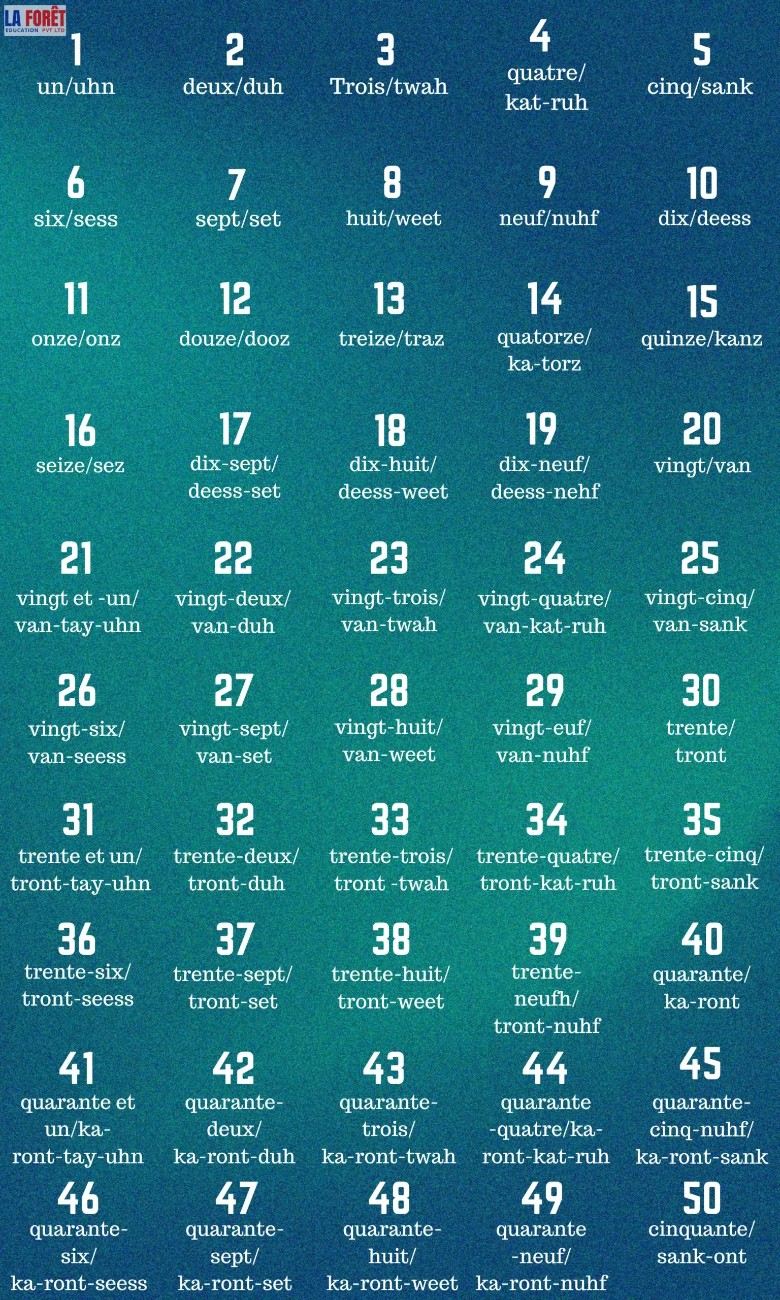
To learn French names and pronunciation for numbers from 1-100 keep reading!
French Numbers 1-20
Let’s start with the basics: the first twenty numbers in French. Knowing these will help you in many everyday situations, such as telling time, shopping, and giving directions.
Below is a table showing the numbers, their French names, and pronunciation.
| Number | French Name | Pronunciation |
|---|---|---|
| 1 | un | uhn |
| 2 | deux | duh |
| 3 | trois | twah |
| 4 | quatre | kat-ruh |
| 5 | cinq | sank |
| 6 | six | seess |
| 7 | sept | set |
| 8 | huit | weet |
| 9 | neuf | nuhf |
| 10 | dix | deess |
| 11 | onze | onz |
| 12 | douze | dooz |
| 13 | treize | trez |
| 14 | quatorze | ka-torz |
| 15 | quinze | kanz |
| 16 | seize | sez |
| 17 | dix-sept | deess-set |
| 18 | dix-huit | deess-weet |
| 19 | dix-neuf | deess-nuhf |
| 20 | vingt | van |
French Numbers 20-40
Continuing from where we left off, here are the numbers from 20 to 40. These numbers are useful for more complex counting, telling the time, and handling money.
| Number | French Name | Pronunciation |
|---|---|---|
| 21 | vingt et un | van-tay-uhn |
| 22 | vingt-deux | van-duh |
| 23 | vingt-trois | van-twah |
| 24 | vingt-quatre | van-kat-ruh |
| 25 | vingt-cinq | van-sank |
| 26 | vingt-six | van-seess |
| 27 | vingt-sept | van-set |
| 28 | vingt-huit | van-weet |
| 29 | vingt-neuf | van-nuhf |
| 30 | trente | tront |
| 31 | trente et un | tront-tay-uhn |
| 32 | trente-deux | tront-duh |
| 33 | trente-trois | tront-twah |
| 34 | trente-quatre | tront-kat-ruh |
| 35 | trente-cinq | tront-sank |
| 36 | trente-six | tront-seess |
| 37 | trente-sept | tront-set |
| 38 | trente-huit | tront-weet |
| 39 | trente-neuf | tront-nuhf |
| 40 | quarante | ka-ront |
French Numbers 40-60
Now, let’s look at the numbers from 40 to 60. These numbers will further enhance your ability to handle various everyday tasks in French.
| Number | French Name | Pronunciation |
|---|---|---|
| 41 | quarante et un | ka-ront-tay-uhn |
| 42 | quarante-deux | ka-ront-duh |
| 43 | quarante-trois | ka-ront-twah |
| 44 | quarante-quatre | ka-ront-kat-ruh |
| 45 | quarante-cinq | ka-ront-sank |
| 46 | quarante-six | ka-ront-seess |
| 47 | quarante-sept | ka-ront-set |
| 48 | quarante-huit | ka-ront-weet |
| 49 | quarante-neuf | ka-ront-nuhf |
| 50 | cinquante | sank-ont |
| 51 | cinquante et un | sank-ont-tay-uhn |
| 52 | cinquante-deux | sank-ont-duh |
| 53 | cinquante-trois | sank-ont-twah |
| 54 | cinquante-quatre | sank-ont-kat-ruh |
| 55 | cinquante-cinq | sank-ont-sank |
| 56 | cinquante-six | sank-ont-seess |
| 57 | cinquante-sept | sank-ont-set |
| 58 | cinquante-huit | sank-ont-weet |
| 59 | cinquante-neuf | sank-ont-nuhf |
| 60 | soixante | swa-sont |
Unique Characteristics
Quarante (40): Forms the base for numbers 41-49.
Cinquante (50): Begins a new decade and is the base for numbers 51-59.
Soixante (60): Marks the start of the sixties.
French Numbers 60-80
Let’s continue with the numbers from 60 to 80. These numbers follow a similar pattern to the previous sets, making them easier to learn once you are familiar with the basics.
| Number | French Name | Pronunciation |
|---|---|---|
| 61 | soixante et un | swa-sont-tay-uhn |
| 62 | soixante-deux | swa-sont-duh |
| 63 | soixante-trois | swa-sont-twah |
| 64 | soixante-quatre | swa-sont-kat-ruh |
| 65 | soixante-cinq | swa-sont-sank |
| 66 | soixante-six | swa-sont-seess |
| 67 | soixante-sept | swa-sont-set |
| 68 | soixante-huit | swa-sont-weet |
| 69 | soixante-neuf | swa-sont-nuhf |
| 70 | soixante-dix | swa-sont-deess |
| 71 | soixante et onze | swa-sont-tay-onz |
| 72 | soixante-douze | swa-sont-dooz |
| 73 | soixante-treize | swa-sont-trez |
| 74 | soixante-quatorze | swa-sont-ka-torz |
| 75 | soixante-quinze | swa-sont-kanz |
| 76 | soixante-seize | swa-sont-sez |
| 77 | soixante-dix-sept | swa-sont-deess-set |
| 78 | soixante-dix-huit | swa-sont-deess-weet |
| 79 | soixante-dix-neuf | swa-sont-deess-nuhf |
| 80 | quatre-vingts | kat-ruh-van |
Unchanged Pattern
Soixante (60): Forms the base for numbers 61-69.
Soixante-dix (70): Literally translates to “sixty-ten,” starting the seventies.
Quatre-vingts (80): Literally means “four twenties,” a unique way of forming the number 80 in French.
French Numbers 80-100
Let’s complete the basic set of French numbers by looking at the numbers from 80 to 100. These numbers continue the patterns we’ve seen, with some unique characteristics for numbers 80 and beyond.
| Number | French Name | Pronunciation |
|---|---|---|
| 80 | quatre-vingts | kat-ruh-van |
| 81 | quatre-vingt-un | kat-ruh-van-tay-uhn |
| 82 | quatre-vingt-deux | kat-ruh-van-duh |
| 83 | quatre-vingt-trois | kat-ruh-van-twah |
| 84 | quatre-vingt-quatre | kat-ruh-van-kat-ruh |
| 85 | quatre-vingt-cinq | kat-ruh-van-sank |
| 86 | quatre-vingt-six | kat-ruh-van-seess |
| 87 | quatre-vingt-sept | kat-ruh-van-set |
| 88 | quatre-vingt-huit | kat-ruh-van-weet |
| 89 | quatre-vingt-neuf | kat-ruh-van-nuhf |
| 90 | quatre-vingt-dix | kat-ruh-van-deess |
| 91 | quatre-vingt-onze | kat-ruh-van-onz |
| 92 | quatre-vingt-douze | kat-ruh-van-dooz |
| 93 | quatre-vingt-treize | kat-ruh-van-trez |
| 94 | quatre-vingt-quatorze | kat-ruh-van-ka-torz |
| 95 | quatre-vingt-quinze | kat-ruh-van-kanz |
| 96 | quatre-vingt-seize | kat-ruh-van-sez |
| 97 | quatre-vingt-dix-sept | kat-ruh-van-deess-set |
| 98 | quatre-vingt-dix-huit | kat-ruh-van-deess-weet |
| 99 | quatre-vingt-dix-neuf | kat-ruh-van-deess-nuhf |
| 100 | cent | sahn |
Unchanged Pattern
Quatre-vingts (80): Continues as the base for numbers 81-89, literally meaning “four twenties.”
Quatre-vingt-dix (90): Translates to “four twenties and ten,” forming the base for numbers 91-99.
Cent (100): Marks the beginning of the hundreds.
Vocab Giving You Trouble? Let’s Fix That!
Join our classes and let our teachers guide you to build a vocabulary that sticks!
French Numbers 100 and Above
Once you reach 100 in French, the patterns change slightly, but they remain logical and manageable. Let’s explore how to form numbers from 100 and beyond, highlighting any new patterns or rules.
Key Numbers and Patterns
100 (cent): The number 100 is “cent” in French. It is used as the base for numbers beyond 100.
Example: 101 is “cent un” (sahn uhn).
101-199: You simply add the number after 100.
Example: 110 is “cent dix” (sahn deess).
Example: 125 is “cent vingt-cinq” (sahn van-sank).
200 (deux cents): For multiples of 100, add the number of hundreds before “cent” and make “cent” plural by adding an “s” if not followed by another number.
Example: 200 is “deux cents” (duh sahn).
Example: 202 is “deux cent deux” (duh sahn duh).
1000 (mille): The number 1000 is “mille” in French. It does not change in the plural form.
Example: 1000 is “mille” (meel).
Example: 1500 is “mille cinq cents” (meel sank sahn).
Million (un million): For a million, use “un million.”
Example: 1,000,000 is “un million” (uhn mee-yon).
Billion (un milliard): For a billion, use “un milliard.”
Example: 1,000,000,000 is “un milliard” (uhn mee-lyar).
Extra Vocabulary for Bigger Numbers
- Thousand: Mille
- Million: Un million
- Billion: Un milliard
- Trillion: Un billion
Ordinal Numbers and Beyond
Ordinal numbers in French are used to indicate order or position, such as “first,” “second,” or “third.” The first ordinal number is “premier” (masculine) or “première” (feminine), while the rest are formed by adding “-ième” to the cardinal number in french, like “deuxième” (second), “troisième” (third), and so on. There are a few exceptions and gender agreements to keep in mind, but the system is generally straightforward.
As you advance in French counting, you’ll encounter unique number formations like “soixante-dix” (70, or “sixty-ten”) and “quatre-vingts” (80, or “four twenties”). These math-based constructions are a distinctive feature of French numbers and can vary depending on regional differences, especially in French-speaking countries outside France. Understanding both ordinal numbers and these special patterns will give you a solid foundation for using French numbers in any context.
French Numbers in Different Dialects
French numbers can vary slightly across different French-speaking regions, such as France, Switzerland, and Belgium. These variations can be important to know, especially if you are travelling or conducting business in these regions.
Key Differences
In Switzerland and Belgium, the numbers 70, 80, and 90 differ from those used in France. This table compares the French numbers for these regions.
| Number | France | Swiss French | Belgian French |
|---|---|---|---|
| 60 | soixante | soixante | soixante |
| 70 | soixante-dix | septante | septante |
| 71 | soixante et onze | septante et un | septante et un |
| 72 | soixante-douze | septante-deux | septante-deux |
| 73 | soixante-treize | septante-trois | septante-trois |
| 74 | soixante-quatorze | septante-quatre | septante-quatre |
| 75 | soixante-quinze | septante-cinq | septante-cinq |
| 76 | soixante-seize | septante-six | septante-six |
| 77 | soixante-dix-sept | septante-sept | septante-sept |
| 78 | soixante-dix-huit | septante-huit | septante-huit |
| 79 | soixante-dix-neuf | septante-neuf | septante-neuf |
| 80 | quatre-vingts | huitante | octante / huitante |
| 81 | quatre-vingt-un | huitante et un | octante et un / huitante et un |
| 82 | quatre-vingt-deux | huitante-deux | octante-deux / huitante-deux |
| 83 | quatre-vingt-trois | huitante-trois | octante-trois / huitante-trois |
| 84 | quatre-vingt-quatre | huitante-quatre | octante-quatre / huitante-quatre |
| 85 | quatre-vingt-cinq | huitante-cinq | octante-cinq / huitante-cinq |
| 86 | quatre-vingt-six | huitante-six | octante-six / huitante-six |
| 87 | quatre-vingt-sept | huitante-sept | octante-sept / huitante-sept |
| 88 | quatre-vingt-huit | huitante-huit | octante-huit / huitante-huit |
| 89 | quatre-vingt-neuf | huitante-neuf | octante-neuf / huitante-neuf |
| 90 | quatre-vingt-dix | nonante | nonante |
| 91 | quatre-vingt-onze | nonante et un | nonante et un |
| 92 | quatre-vingt-douze | nonante-deux | nonante-deux |
| 93 | quatre-vingt-treize | nonante-trois | nonante-trois |
| 94 | quatre-vingt-quatorze | nonante-quatre | nonante-quatre |
| 95 | quatre-vingt-quinze | nonante-cinq | nonante-cinq |
| 96 | quatre-vingt-seize | nonante-six | nonante-six |
| 97 | quatre-vingt-dix-sept | nonante-sept | nonante-sept |
| 98 | quatre-vingt-dix-huit | nonante-huit | nonante-huit |
| 99 | quatre-vingt-dix-neuf | nonante-neuf | nonante-neuf |
Notable Differences and Practical Implications
- Septante (70): Used in Swiss and Belgian French instead of “soixante-dix.”
- Huitante/Octante (80): “Huitante” is more common in Switzerland, while “octante” is sometimes used in Belgium, though “huitante” can also be heard.
- Nonante (90): Used in both Swiss and Belgian French instead of “quatre-vingt-dix.”
Practical Implications
- Travel: Knowing these variations helps in understanding and communicating numbers correctly when traveling in these regions.
- Business: Correct usage of regional numbers ensures clear communication and avoids misunderstandings in transactions and negotiations.
- Education: Teaching French learners the regional variations can enhance their comprehension and versatility in using the language.
If you’re eager to learn and practise French check our article on Ideas for Daily French Practice and also French alphabet. And to get personalised coaching from experienced tutors check our courses at La Forêt French Class.
Frequently Asked Questions
Q1: How to count from 1 to 10 in French?
Ans: Start by learning the basics: “un” (1), “deux” (2), “trois” (3), “quatre” (4), “cinq” (5), “six” (6), “sept” (7), “huit” (8), “neuf” (9), and “dix” (10).
Q2: Is there a French word for 70?
Ans: Yes, in France, the word for 70 is “soixante-dix.” However, in Switzerland and Belgium, the term “septante” is used instead. Explore these variations and more with La Forêt’s cultural insights and language resources.